
Why Regular Professional Teeth Cleaning Matters More Than You Think
Discover how professional teeth cleaning, scaling and root planing can prevent gum disease, protect your overall health, and save your natural teeth. See a real patient transformation from Perfect Dental Studio, BTM Layout, Bangalore.
Professional Teeth Cleaning: The Clean Your Brush Always Misses
Professional teeth cleaning is a procedure done by a dentist or hygienist that removes plaque, tartar, and bacteria from tooth surfaces and below the gum line using professional instruments. Unlike brushing and flossing at home, it reaches the deposits your routine simply cannot touch.
You brush twice a day. You floss. You rinse. And you still assume your teeth are fine. Here is the problem. None of that touches the tartar sitting below your gum line. Once plaque hardens into calculus, it is stuck to the tooth, and nothing at home shifts it. Skip professional cleaning long enough, and those deposits stop being harmless. Gingivitis shows up first. Then periodontitis. Then gum recession, bone loss, and eventually, teeth start going. None of it makes noise. It just builds.
Scaling and Root Planing: When Cleaning Goes Deeper
Scaling and root planing is a non-surgical periodontal treatment that cleans above and below the gum line, removing hardened tartar from tooth roots and smoothing the surfaces so bacteria have less to hold onto. It goes where a regular cleaning simply cannot reach, and it is recommended when gum disease has already progressed beyond routine care.
At Perfect Dental Studio in BTM Layout, Bangalore, we had a patient come in with exactly that. Heavy tartar, inflamed gums, and bone loss are already showing. Treated with scaling and root planing. The one-week results are worth knowing about.
The Case: What We Saw Before Scaling and Root Planing
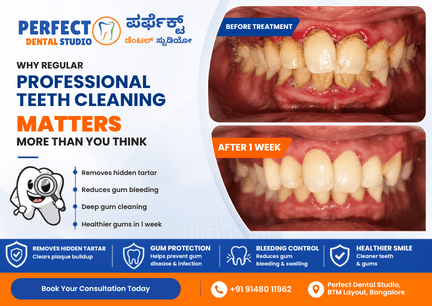
Clinical presentation before scaling and root planing – heavy tartar accumulation and generalised gum inflammation.
Initial Diagnosis: What the Patient Presented With
The signs were not subtle. Calculus sitting heavy above the gum line. More of it below where no brush gets to. Gums inflamed everywhere. Bleeding every single time they brushed. Chronic bad breath wasn't being fixed. And bone loss is already showing up on the examination.
Straight to scaling and root planing. No waiting. Infection needed to be controlled, and the supporting structures needed to be protected before anything else deteriorated.
The Procedure: Step-by-Step Through Scaling and Root Planing
Scaling and root planing is not your regular cleaning. It is a non-surgical periodontal treatment. Above the gum line, below it, properly.
- Ultrasonic instruments first. Broke up the hardened tartar.
- Hand instruments after that cleared the rest.
- Root surfaces cleaned and smoothed so bacteria have less to hold onto going forward.
- Toxins removed. Inflamed tissue decontaminated. Gave the body something real to work with.
Patient was comfortable the whole way through. Came back at one week.
1-Week Results: What Changed After Professional Dental Cleaning?
One-week review following scaling and root planing – cleaner teeth and healthier gum tissues.
Visible Changes in Calculus Deposits
One week. The difference was sitting right there on the surfaces. Tartar gone. Teeth cleaner than they had been in a long time. The rough spots where plaque kept building up were cleared. Patient said home cleaning felt easier already. That is exactly what you want because that is what keeps things going in the right direction.
Professional cleaning gets to where brushing cannot. The before and after say it plainly.
Gum Tissue Healing: Early Signs of Periodontal Recovery
Tissue was already responding at one week. Inflammation down. Redness reduced. Swelling down. Tissue tone better. Bleeding noticeably less.
Still early. But moving the right way. The foundation is there for the recovery to continue, provided home care keeps up.
The Silent Danger: Why Periodontitis Goes Unnoticed Until It Is Too Late
Here is what gets people. Periodontitis does not hurt. Early stages, middle stages, and sometimes even when serious damage is already done. Nothing that makes you think of coming in.
Bone going. Gums pulling back. Teeth loosening. Infection spreading. And the person feels nothing alarming.
No pain, no problem. That is the thinking. But this disease does not need to hurt to destroy things. By the time it actually feels wrong, a lot of the damage is already done, and a lot of it cannot be reversed.
Warning Signs You Should Never Ignore
- Bleeding gums when you brush or floss
- Bad breath that keeps coming back no matter what
- Visible tartar on the teeth
- Gums pulling back or teeth looking longer than usual
- Temperature sensitivity
- Teeth feeling loose or bite feeling different
- Gums swollen or tender
- Teeth not fitting together the way they used to
Any of these come in. Earlier always means easier, cheaper, and more effective.
Gum Disease Is Not Just a Mouth Problem: The Systemic Connection
People think gum disease is just a dental thing. Research disagrees. Chronic periodontal inflammation ties into systemic conditions in ways that matter.
Periodontitis and Diabetes: A Two-Way Relationship
Goes both ways. Poorly controlled diabetes makes gum disease worse. An active gum infection makes blood sugar harder to manage. Treating gum disease in diabetic patients regularly produces measurable improvement in blood sugar control. Anyone managing both needs to understand that periodontal treatment is not a side issue. It is part of managing their health overall.
Links to Cardiovascular Disease, Stroke and Respiratory Conditions
Periodontitis has been linked to cardiovascular disease, stroke, respiratory infections, and pregnancy complications. Gum disease does not directly cause these, but the chronic low-grade inflammation running underneath may be feeding into broader health risks. In the same quiet way, it damages the mouth.
Worth treating early for that reason alone.
Why Professional Cleaning at a Dental Clinic Is Different from Brushing at Home
Brushing handles soft plaque well. But calculus is not soft plaque. Once it hardens, it is bonded to the surface, and nothing over the counter touches it. Only professional instruments can remove it safely from above and below the gum line.
Not a brushing problem. Not a frequency problem. Just what calculus is and what it takes to deal with it. Professional teeth cleaning remains essential even for patients who are genuinely good at looking after their teeth at home.
Periodontal Care Is a Long-Term Commitment: What Comes After Scaling?
One appointment starts it. Does not end it. Positive results at one week, but the long-term outcome comes down to what happens after. Home care. Maintenance visits. Monitoring.
Your Home Care Routine After Scaling and Root Planing
- Brush twice a day with a soft-bristle toothbrush.
- Floss or use interdental brushes every day, no skipping.
- Prescribed mouthwash as directed.
- A diet that supports healing.
- No tobacco. Slows recovery significantly.
How Often Should You Come Back for Periodontal Maintenance?
- Every 3 to 4 months to start.
- Every 6 months, once stable.
- More often, if the periodontist recommends it based on how things are responding.
Bacteria recolonise over time. Regular professional dental cleaning at the right intervals stops that from tipping back into active disease.
Book Your Professional Teeth Cleaning Consultation Today
Bleeding gums. Visible tartar. Bad breath that won't go away. Gums pulling back. Teeth feel different. If any of that is familiar, come in now. Not when it gets worse.
At Perfect Dental Studio in BTM Layout, Bangalore, we provide professional teeth cleaning, scaling and root planing, and gum disease treatment built around what each patient actually needs.
📅 Book Consultation 💬 Ask Our Experts📞 +91 91480 11962 | 📍 BTM Layout, Bangalore
Conclusion
This case shows what professional teeth cleaning, scaling and root planing actually do. Tissue responding at one week. But the real value is what it stops. Bone loss. Gum recession. Tooth loss. None of that is inevitable. It is just what happens when gum disease gets left alone.
Consistent cleaning, early diagnosis, and proper maintenance. That is what keeps your teeth. Bleeding gums, tartar, and bad breath that keeps coming back are not normal, and none of it should be ignored.
Catch it early. Treatment is easier, cheaper, and more effective every single time.
Frequently Asked Questions About Teeth Cleaning and Gum Disease
What is professional teeth cleaning?
Removes plaque, tartar, and bacteria from tooth surfaces and below the gum line using professional instruments. Gets to where home care cannot.
Is scaling and root planing painful?
No. Local anaesthesia is used where needed. Comfortable throughout.
What happens after teeth scaling?
Some sensitivity and mild soreness for a few days is normal. At one week, most patients show reduced inflammation, less bleeding, and cleaner surfaces.
How often should I get a professional teeth cleaning?
Every 6 months for healthy gums. Every 3 to 4 months after periodontal treatment, adjusted as things respond.
Can gum disease be cured?
Gingivitis can be reversed with professional cleaning and better home care. Advanced periodontitis cannot be fully reversed, but can be stabilised and controlled with proper treatment and maintenance.
Is bleeding gums a sign of gum disease?
Yes. One of the earliest signs. Bleeding when you brush or floss is not normal. It needs attention.
Does gum disease affect heart health?
Research links periodontal inflammation to cardiovascular disease. Gum disease does not directly cause heart conditions, but the ongoing inflammation may contribute to broader cardiovascular risk.
Is brushing enough to remove tartar?
No. Brushing handles soft plaque. Once it hardens into tartar, only professional cleaning removes it. Does not matter how well or how often you brush.
© 2026 Perfect Dental Studio – Professional Teeth Cleaning & Gum Disease Treatment in Bangalore
📞 +91 91480 11962 | 📧 perfectdentalstudio@gmail.com
*Educational content only. Consult our specialists for personalised diagnosis and treatment recommendations.
📞 +91 91480 11962 | 📧 perfectdentalstudio@gmail.com
*Educational content only. Consult our specialists for personalised diagnosis and treatment recommendations.